
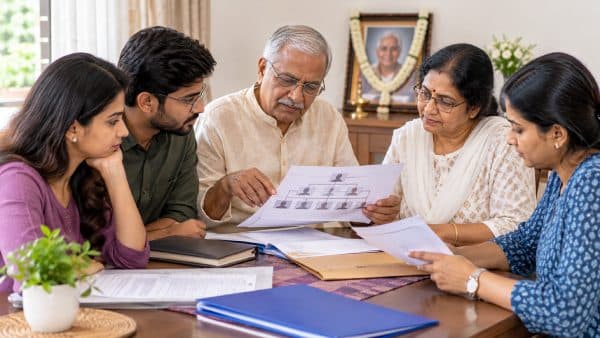
Family Tree / Legal Heir Certificate: When Banks, Property and Pension Ask for It
Family tree, legal heir and succession certificates has different purposes. Know which one you need for bank funds, property mutation and pension in Karnataka.
Family Tree / Legal Heir Certificate: When Banks, Property and Pension Ask for It
Quick answer: After a family member dies, the document required depends on what you are trying to claim or update. A family tree certificate records family relationships; a legal heir certificate is an administrative document used for specified claims; and a succession certificate is a court-issued authority mainly for collecting debts and securities. They are not interchangeable. In Bengaluru Urban, the district administration states that legal heir certificates are issued only to kin of deceased government servants, while others may need to approach the civil court for a succession certificate where that is the relevant document. Property title and mutation may require a different process.
Why These Documents Are Requested After a Death
Banks, government departments, insurers, employers and land-record offices need to identify who is entitled to act after a person's death. They may ask for a death certificate first and then request evidence of relationship, heirship, authority to collect money or entitlement to a specific asset. The document name used by an institution is not always legally precise. Ask the institution to state exactly what it needs, for which asset and under which rule or policy. A family tree may be enough for one administrative purpose but not sufficient to collect a disputed bank deposit or transfer title to land.What Is a Family Tree / Vamsha Vruksha Certificate?
A family tree or Vamsha Vruksha document sets out the deceased person's family relationships, usually identifying the spouse, children and other relevant relatives. It can help an authority understand the family structure and identify potential heirs. It is not, by itself, a court decree distributing the estate. It does not automatically prove that a particular person is the sole owner of every asset, resolve a dispute between relatives or replace a succession certificate where one is legally required. The issuing office and evidentiary value should be checked for the purpose at hand.What Is a Legal Heir Certificate in Karnataka?
A legal heir certificate is commonly used in administrative claims to identify the legal heirs of a deceased person. Karnataka district administration guidance, including the Bengaluru Urban district page, states that this certificate is now issued only to the kin of deceased government servants. It directs others to obtain a succession certificate through the jurisdictional civil court where that court document is required. Some Karnataka district pages and service channels may describe different local workflows or legacy procedures. Do not assume that a general online checklist applies to every district, asset or applicant. Confirm the current rule with the relevant Tahsildar/Nada Kacheri, employer or court registry.What Is a Succession Certificate?
A succession certificate is issued by a competent civil court under Part X of the Indian Succession Act, 1925. It primarily authorises the holder to collect specified debts and securities due to the deceased, such as certain bank deposits, financial claims or securities. The petition identifies the deceased, the applicant's claim, near relatives and the debts/securities covered. The court gives notice and follows the statutory procedure. A succession certificate is not a universal title deed for all immovable property and does not replace every probate, letters-of-administration, partition or mutation requirement.Which Document Is Usually Relevant?
| Situation | Document often considered | Important limit |
|---|---|---|
| Establishing family relationships for an administrative purpose | Family tree / Vamsha Vruksha, if accepted by the receiving office | Does not itself distribute the estate or settle disputes. |
| Family pension or service benefits after a government employee's death | Legal heir certificate or the department's prescribed family/pension documents | Check the deceased employee's department and current Karnataka procedure. |
| Collecting specified bank debts or securities where the bank requires court authority | Succession certificate | Its scope is the debts and securities described in the certificate. |
| Mutation or transfer of an immovable property record | Death certificate, title documents, heir/relationship evidence and the relevant mutation/registration documents | Mutation is not the same as adjudication of title; disputes may require court proceedings. |
| Claim under a valid Will | Will and the appropriate probate/letters/administration or transfer process, depending on facts and location | A family tree certificate does not override a Will. |
When Banks Ask for a Document
Start with the bank's deceased-claim form and ask whether it has a nomination, joint holder or survivorship instruction. The bank may process a straightforward claim through its internal procedure and indemnity documents; a succession certificate may be requested where there is no nomination, competing claimants, a dispute or a risk issue. Do not assume that every bank account requires a succession certificate. Conversely, a family tree alone may not be enough where the bank specifically requires a court-issued certificate. Ask the bank for its written checklist and whether it accepts indemnities and no-objection declarations from all heirs.Property, Pension and Other Claims
For property, the family may need to update the municipal/revenue record, khata, mutation or ownership record. The authority will typically need the death certificate and title chain, together with documents establishing the heirs or the effect of a Will. If heirs disagree, a revenue certificate cannot settle the dispute. For pension and service benefits, the deceased person's employer or pension authority may have a specific legal-heir/family-pension process. A government employee's family should approach the department or treasury with the death certificate and service details before applying for a generic certificate.Documents to Collect Before Applying
Keep a common file with:- death certificate of the deceased;
- identity and address proof of the applicant and family members;
- proof of relationship, such as birth or marriage certificates;
- family details, addresses and contact information of all known heirs;
- the deceased's Aadhaar/PAN or service details, where available and relevant;
- Will, if one exists;
- bank account, deposit, share or policy details for financial claims; and
- property title deed, khata/RTC or tax records for immovable property matters.
Where DocuPro Fits In
DocuPro's Family Tree service can help families organise relationship details, prepare the supporting document set and navigate the relevant application route for a family-tree record. This is useful when banks, departments or property offices ask for a clear record of the family structure. A family tree is not a substitute for a court-issued succession certificate, probate, letters of administration or a property-title decision. The receiving authority decides what it will accept, and contested inheritance matters may require a lawyer and court process. DocuPro cannot guarantee that a family tree will satisfy every bank, pension office or Sub-Registrar.Frequently Asked Questions
1. Is a family tree certificate the same as a legal heir certificate?
No. A family tree records relationships. A legal heir certificate is an administrative document for specified claims. Their purpose and acceptance differ.
2. Is a succession certificate needed to transfer property?
Not automatically. A succession certificate primarily covers debts and securities. Immovable property transfers may require title, mutation, probate or other proceedings depending on the facts.
3. Can all family members apply together?
Often it is helpful to provide complete details and consent/no-objection documents from all heirs, but the exact applicant and signatures depend on the authority and claim.
4. Who gets a legal heir certificate in Bengaluru?
The Bengaluru Urban district administration states that it is issued only to kin of deceased government servants. Others may need a civil-court succession certificate where that is the required document.
5. Does a nominee automatically become the owner of the deceased person's assets?
Nomination often enables the institution to release or administer an asset, but beneficial succession rights may still depend on the applicable personal law, Will and facts.
Accuracy note: This article is general information, not legal, tax or regulatory advice. Rules, forms, fees, jurisdictional practice and portal workflows may change. Confirm the latest requirements with the competent authority and obtain professional advice for disputed, high-value or unusual cases.