
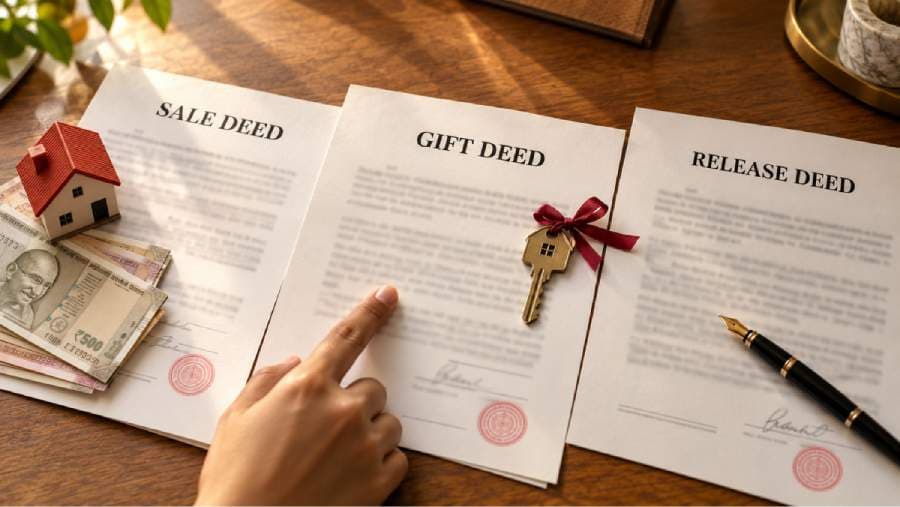
Sale Deed vs. Gift Deed vs. Release Deed: What's the Difference?
Not sure which property deed you need? Learn how sale, gift and release deeds differ in stamp duty, tax, and use, and avoid costly legal mistakes.
Sale Deed vs. Gift Deed vs. Release Deed: What's the Difference?
Quick answer: Choosing between a Sale Deed, Gift Deed, and Release Deed depends entirely on the nature of the transaction and the relationship between the parties. A Sale Deed is used when buying or selling property for money, incurring full stamp duty and capital gains tax. A Gift Deed voluntarily transfers ownership without any monetary consideration, often benefiting from concessional stamp duty and tax exemptions among close relatives. A Release (or Relinquishment) Deed surrenders a co-owner’s or legal heir’s share in a joint/ancestral property to another co-owner. Selecting the wrong legal instrument can lead to financial penalties, invalid ownership claims, or legal disputes.
Overview of Property Transfer Deeds
When it comes to property ownership and transfer in real estate, legal documentation is the backbone of every transaction. Whether you are buying a home, transferring ancestral property to a family member, or relinquishing your share in a jointly owned property, executing the right legal instrument is critical.
Three of the most common legal documents used for property transfers are the Sale Deed, Gift Deed, and Release Deed. While all three transfer property rights from one party to another, they serve distinct purposes, carry different financial and tax implications, and require specific legal procedures.
Using the wrong deed can lead to severe financial penalties, invalid ownership claims, or lengthy legal disputes. This detailed guide breaks down everything you need to know about Sale Deeds, Gift Deeds, and Release Deeds—their legal definitions, key differences, tax implications, and execution processes.
Understanding Property Transfer Instruments
Before diving into comparisons, it is essential to understand the basic legal framework governing property transfers. Under Indian law, property transfers are primarily governed by the Transfer of Property Act, 1882 and the Indian Registration Act, 1908.
Every valid transfer requires:
- Competent Parties: Grantor/transferor and grantee/transferee of sound mind and legal age.
- Transferable Property: Clear ownership title free from legal encumbrances (unless disclosed).
- Legal Instrument: A written, signed, and registered legal document executed before a Sub-Registrar.
What is a Sale Deed?
Definition
A Sale Deed (also known as a Title Deed or Conveyance Deed) is a legal document that evidences the absolute sale and transfer of ownership of a property from a seller (vendor) to a buyer (vendee) in exchange for a monetary consideration (price).
Key Features of a Sale Deed
- Consideration: Requires monetary consideration (the sale price).
- Absolute Transfer: Transfers full, unconditional ownership rights to the buyer.
- Irrevocable: Once executed and registered, a Sale Deed cannot be unilaterally canceled by the seller unless ordered by a court of law due to fraud, misrepresentation, or non-payment.
- Indemnity Clause: Typically includes a covenant protecting the buyer against future claims or legal defects in title arising from the seller's past ownership.
When is a Sale Deed Used?
- Buying or selling residential apartments, houses, or commercial properties between unrelated parties or business entities.
- Purchasing land or plots from private owners, developers, or government authorities.
Financial Implications
- Stamp Duty & Registration Charges: High (typically ranges based on state/jurisdiction rates on the consideration amount or the government circle rate, whichever is higher).
- Taxation: The seller is subject to Capital Gains Tax (Short-Term or Long-Term Capital Gains Tax depending on the holding period).
What is a Gift Deed?
Definition
A Gift Deed is a legal document used to voluntarily transfer the ownership of a movable or immovable property from a donor (the person giving the property) to a donee (the person receiving the property) without any monetary consideration or payment.
Key Features of a Gift Deed
- Zero Consideration: Executed out of love, affection, or goodwill; no money changes hands.
- Mandatory Acceptance: The donee must accept the gift during the lifetime of the donor and while the donor is capable of giving. If the donee dies before accepting, the gift deed becomes void.
- Registration Mandatory: Section 17 of the Registration Act makes registration of a Gift Deed mandatory for immovable property.
- Irrevocability: A registered Gift Deed cannot be revoked arbitrarily unless a specific revocation clause was mutually agreed upon in the deed itself or if procured through coercion or fraud.
When is a Gift Deed Used?
- Gifting property to blood relatives (spouse, children, siblings, parents).
- Donating property to charitable institutions, trusts, or non-profits.
Financial Implications
- Stamp Duty: Many jurisdictions offer concessionary or reduced stamp duty rates when property is gifted to close/blood relatives.
- Taxation: Gifts received from "specified relatives" (as defined under tax laws) are usually exempt from Income Tax. Gifts received from non-relatives exceeding specified threshold limits (e.g., ₹50,000 in India) are taxable as income in the hands of the recipient.
What is a Release Deed (or Relinquishment Deed)?
Definition
A Release Deed (often called a Relinquishment Deed) is a legal instrument through which a legal heir or co-owner surrenders, releases, or relinquishes their legal rights, title, and interest in a jointly owned or ancestral property in favor of another co-owner or legal heir.
Key Features of a Release Deed
- Co-Owners Only: Can only be executed between co-owners or co-sharers who already possess an existing title or legal claim in the property.
- Consideration Optional: Can be executed either with monetary consideration (where one co-owner buys out another's share) or without consideration (gratuitous surrender).
- Irrevocable: Once registered, the releasing party surrenders all future rights and claims to the specified share in the property permanently.
When is a Release Deed Used?
- Settling ancestral property disputes among legal heirs (e.g., siblings relinquishing their share of inherited property in favor of one sibling or a surviving parent).
- Transferring ownership in jointly purchased properties following a divorce or legal settlement.
Financial Implications
- Stamp Duty: Generally lower than a standard Sale Deed when executed among legal heirs/family members.
- Taxation: If consideration is paid for relinquishing the share, Capital Gains Tax applies to the releasor. If done without consideration among specified legal heirs, tax exemptions usually apply.
Comparative Analysis: Sale Deed vs. Gift Deed vs. Release Deed
| Feature / Criteria | Sale Deed | Gift Deed | Release Deed |
|---|---|---|---|
| Primary Purpose | Sale and transfer of property for money | Voluntary transfer of property out of affection/goodwill | Surrender of co-ownership share to another co-owner |
| Consideration | Mandatory (Monetary consideration) | Strictly None (Zero consideration) | Optional (Can be with or without consideration) |
| Parties Involved | Seller (Vendor) and Buyer (Vendee) | Donor (Giver) and Donee (Receiver) | Releasor (Surrendering party) and Releasee (Acquiring party) |
| Relationship between Parties | Any parties (related, unrelated, corporate) | Usually blood relatives or charitable entities | Must be co-owners, legal heirs, or joint title holders |
| Stamp Duty Rates | High (Full market value / Circle rate standard) | Low/Concessional for close relatives; High for non-relatives | Generally low/concessional among family members |
| Acceptance Requirement | Standard contractual execution | Acceptance by Donee during Donor's lifetime is mandatory | Acceptance by Releasee |
| Tax Impact | Capital Gains Tax for seller; Stamp duty for buyer | Tax-free among specified relatives; Taxable for non-relatives | Capital Gains Tax if consideration is paid; Exempt if gratuitous |
| Irrevocability | High; requires judicial court decree to cancel | High; non-revocable unless conditional clause exists | High; permanent surrender of legal rights |
Step-by-Step Execution Process for Property Deeds
Executing any of these deeds requires strict adherence to statutory compliance. Here is the standard legal workflow:
- Title Search and Verification: Conduct a legal title search (13 to 30 years) to verify ownership, chain of title, and ensure the property is free of mortgages, liens, or court litigation.
- Drafting the Deed: Draft the agreement incorporating essential clauses:
- Identity and details of all parties.
- Comprehensive description of the property (survey numbers, boundaries, schedule of property).
- Consideration clause (for Sale Deed / paid Release Deed) or Love & Affection clause (for Gift Deed).
- Title transfer and possession handover date.
- Indemnity and covenant clauses.
- Stamp Duty Payment: Purchase non-judicial stamp paper or pay e-stamp duty appropriate to the transaction type and local state laws.
- Execution and Attestation: Sign the deed in the presence of at least two independent witnesses.
- Registration: Present the document before the Sub-Registrar of Assurances having local jurisdiction over the property location within the statutory period (typically 4 months from execution).
- Mutation of Property: Apply for property mutation in local municipal records to update revenue records and tax assessment logs under the new owner's name.
Common Legal Pitfalls to Avoid
- Incorrect Instrument Selection: Executing a Gift Deed to avoid taxes when consideration actually changed hands can lead to legal invalidation and criminal penalties for tax evasion.
- Non-Registration: Unregistered property deeds transferring immovable property above minimal threshold values have no legal validity in court under Section 49 of the Indian Registration Act.
- Missing Witnesses: Gift Deeds and Sale Deeds require valid attestation by two witnesses; failure to ensure proper attestation can void the transaction.
- Ignoring Encumbrance Certificates: Failing to obtain an updated Encumbrance Certificate (EC) before executing a Release Deed or Sale Deed may leave you responsible for pre-existing debts secured against the property.
How DocuPro Helps
Navigating property documentation, stamp duty calculations, title verifications, and registration procedures at state Sub-Registrar Offices (SRO) can be overwhelming. DocuPro provides end-to-end legal and documentation support to simplify property transfers and ensure complete legal compliance.
Our Property Documentation Services Include:
- Expert Title Verification: Thorough legal vetting of property documents and encumbrance checks to ensure 100% clean title ownership.
- Custom Drafting by Legal Experts: Custom drafting of Sale Deeds, Gift Deeds, and Release Deeds tailored to your specific transaction context and family structure.
- Stamp Duty & Tax Optimization Guidance: Expert calculation of applicable stamp duties, registration fees, and insights into tax implications under current laws.
- Sub-Registrar Registration Support: Complete assistance with scheduling appointments, document submission, and physical execution at the Sub-Registrar’s office.
- Property Mutation Assistance: Post-registration support to ensure seamless mutation of ownership records with municipal bodies and revenue departments.
Partner with DocuPro to safeguard your property transactions against legal disputes, administrative delays, and procedural errors.
Frequently Asked Questions (FAQs)
1. What is the main difference between a Sale Deed, Gift Deed, and Release Deed?
A Sale Deed transfers property ownership in exchange for money. A Gift Deed transfers ownership voluntarily without any monetary consideration (usually out of love and affection). A Release Deed surrenders a co-owner's or legal heir's existing share in a jointly owned property to another co-owner.
2. Can a Gift Deed be revoked after registration?
Generally, a registered Gift Deed is irrevocable once accepted by the donee. However, it can be revoked if a specific revocation clause was included in the deed itself, or if it is proven in court that the gift was obtained through fraud, coercion, undue influence, or misrepresentation.
3. Is stamp duty lower for a Gift Deed compared to a Sale Deed?
Yes, in many jurisdictions and Indian states, stamp duty on a Gift Deed executed in favor of immediate blood relatives (spouse, children, parents, siblings) is significantly lower or capped at a concessionary rate compared to the standard stamp duty levied on a Sale Deed.
4. Can a Release Deed be executed in favor of a third party or non-family member?
No. A Release Deed can only be executed in favor of an existing co-owner or legal heir who already holds a share in the property title. To transfer property rights to an unrelated third party, a Sale Deed or Conveyance Deed must be used.
5. What are the capital gains tax implications on a Sale Deed versus a Gift Deed?
In a Sale Deed, the seller must pay short-term or long-term Capital Gains Tax based on the profit made over the holding period. In a Gift Deed, no capital gains tax applies at the time of gifting for relatives; however, if the donee later sells the property, capital gains tax is calculated using the original owner's purchase cost and holding period.
6. Can I transfer ancestral property using a Gift Deed?
An individual can only gift their specific legal share of ancestral property or self-acquired property. An individual cannot gift the entire ancestral property without the explicit legal consent of all coparceners or legal heirs who hold rights in that property.
7. Is registration mandatory for a Release Deed to be legally valid?
Yes. Under Section 17 of the Indian Registration Act, 1908, any legal instrument that relinquishes or transfers rights in an immovable property valued above ₹100 must be registered at the local Sub-Registrar office to be legally valid and enforceable.
8. What happens if a donee does not accept a Gift Deed during the donor's lifetime?
Under property law, acceptance by the donee during the donor’s lifetime is a mandatory legal requirement. If the donee dies before formally accepting the gift, or if the donor dies before the donee accepts, the Gift Deed becomes legally void.
9. Can a Release Deed be executed with monetary consideration?
Yes, a Release Deed can be executed either gratuitously (without money) or for monetary consideration. When monetary consideration is paid by one co-owner to acquire another co-owner's share, the releasing party may be liable for Capital Gains Tax on the consideration received.
10. How long does it take to register a Sale Deed or Release Deed at the Sub-Registrar office?
Once drafting and stamp duty payments are complete, physical registration at the Sub-Registrar office usually takes 1 to 3 business days, depending on slot availability, document verification, and regional administrative workflows.
Legal provisions and stamp duty rates mentioned in this article are indicative and subject to statutory amendments by state governments. Verify current regulations and registration procedures with qualified legal counsel or a licensed documentation partner like DocuPro before executing property transactions.